David Batty (part one) ⭑ From A-Z since '92
David Batty was surprised by his own emotions when saying goodbye to Howard Wilkinson, the authority figure who had spent much of the last five years berating him for one thing or another. Wilko, respecting Batty's obstinance and admiring his talent, didn't actually want him to go.
This is part of my (eight year long, it'll fly by) attempt to write about every Leeds United player since 1992. For more about why I'm doing this, go back to Aapo Halme, and to read all the players so far, browse the archive here.
This series is dealing with the Premier League era, because everything before 1992 was covered wonderfully in the book that inspired it all. So we have to skip through the years that made David Batty a Leeds and Leeds United icon, an England international, a winner of two titles.
They were the years that made every Leeds fan want to be David Batty. He'd graduated from Leeds City Boys to the club's junior teams, where he was raised by Eddie Gray and mentored by Billy Bremner. He was little but he was hard, a no-nonsense midfielder with a sceptical smile. He was John Sheridan's mate, then he was Vinnie Jones' mate, when everyone wanted to be their mate. As he grew up and filled out, his hair grew into blond curtains with a lovely bounce, the envy of every lad going down Mr Craig's on the weekend. Now everyone wanted to be David Batty's mate. And, in between fucking up First Division midfielders with big reputations, he kept on playing that heel pass Billy Bremner taught him and giving older supporters a tingle of the olden days.
The question we can't avoid is, when 1993 comes around, why did Leeds United ever sell him? Part of answering that, though, leads us to another question: why did he want to go?
Selling Batty to Blackburn Rovers was an agonising consequence of Leeds United's 1990s success. One factor was simply cashflow. As First Division champions, playing in the Champions League, Leeds had built a 'new, magnificent' 17,000 capacity stand on Lowfields Road. They'd spent £2m buying David Rocastle, and £2.7m buying Brian Deane. The cheque that chairman Leslie Silver held aloft as prize for winning the league in 1992 had been worth £100,000, and that illustrated the problem. The rest was being underwritten by Silver, the board, and willing sponsors. When a bid arrived for a player that would pay back what had just gone out on Deane, while contractors' bills for the new stand were piling up, the club had to consider it.
The other major factor in United's success was Howard Wilkinson, and while he'd brought the glory days back to Elland Road by building the best midfield in the country, it had not brought the same joy to Batty as it had to the fans. Wilko's management of Batty answers, in some ways, the accusations that he couldn't deal with 'difficult' players. Even as a youngster Batts was an intransigent individual who was bored stiff by training, and Wilko managed to mould him into a professional of international class. But they could only work with each other for so long.
Wilkinson's first impression of Batty, he said, was of a "lunatic", but a player whose talent was worth the indulgence. It wasn't only Wilko who struggled with him: bought to instil order, new captain Gordon Strachan soon realised he couldn't do anything with Batts. So while Strachan worked on impressionable youngsters like Gary Speed, Wilkinson brought in his polar opposite, Vinnie Jones, to take charge of Batty. Even then, Wilko preferred the experience of Chris Kamara alongside Jones to win promotion — wisely, given Batty deliberately conceded a penalty in one game to annoy his dad — but in the First Division Batty was given his freedom alongside Gary McAllister and played what he considered the best and most enjoyable football of his Leeds career.
And then success beckoned. After adding the pace of Tony Dorigo and Rod Wallace, Wilkinson rethought his tactics, taking Leeds beyond their strict 4-4-2. Batty was asked to drop deep between the centre-backs, a move that brought the title to Elland Road but took the fun out of things for Batty. The title defence was even worse. The team slumped to 17th and Batty, when he wasn't injured, was being played out of position to cover right-back. The curtains had long gone, replaced by a close crop, and the title aura was fading.
As 1993/94 began, relations between the strict manager and his idiosyncratic midfielder were, personally, finally, good. Batty was surprised by his own emotions when saying goodbye to Wilkinson and his assistant Mick Hennigan, two authority figures who had spent much of the last five years berating him for one thing or another. Wilko, respecting Batty's obstinance and admiring his talent, didn't actually want him to go, but the board pointed out he'd have to sell someone to buy the players his squad needed. "I hope nobody thinks I have such a big ego that I now intend to take my bat and ball home because I feel a bit miffed," about having to sell, he said.
But given the chance to leave, Batty didn't think twice. He hadn't been thinking about it at all until, as he was coming off the bench at Elland Road against Blackburn, the Rovers' captain Tim Sherwood told him, "You'll be at Blackburn next week." That prospect didn't get between Batty and smacking Blackburn's striker Mike Newell, but as he sat up in bed the next night talking on the phone to their manager Kenny Dalglish, Batty realised this was what he'd wanted for ages: a change.
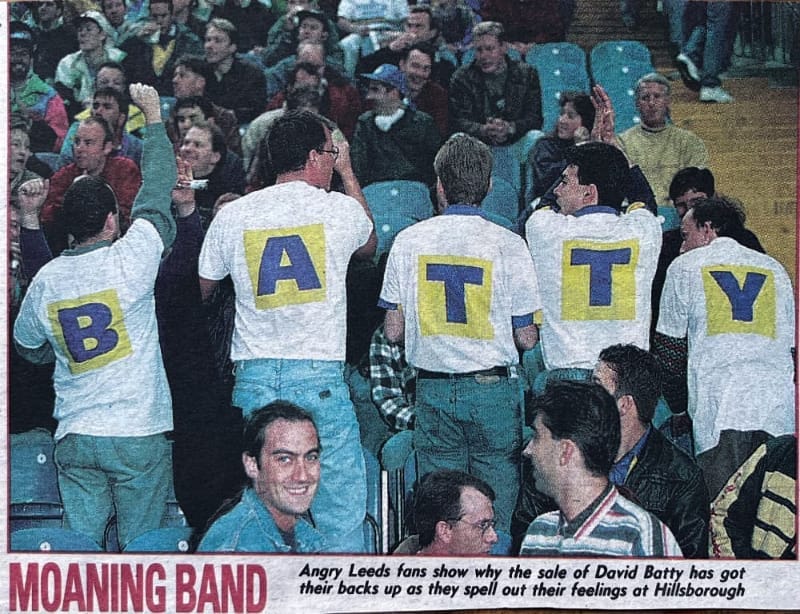
The club's fans were not so sanguine. Radio Leeds hosted an angry two hour phone-in, a Yorkshire Evening Post poll was 94 per cent against the sale, The Square Ball fanzine published a TSB supplement under the name They Sold Batty. £2.7m had bought Deane, who wasn't scoring; £2.75m had come back in, for the club's hometown hero; later £2.6m went out again, for Carlton bloody Palmer.
And, meanwhile, Blackburn bloody Rovers kept on buying multi-million pound players, challenging for and then winning the Premier League title. Dalglish, the story went, had never forgotten playing alongside Batty in John Charles' and Bobby Collins' testimonial at Elland Road in 1988, and trusted him to run his midfield the way he wanted, without the rules and regulations of a Howard Wilkinson team.
To keep reading, please become a More to Read or More Listening member
Leedsista is supported by Leeds fans who think decent writing about their football team is worth £3 a month to read, or £5 a month for a podcast version.
Try free for 30 days.